Reading Your Brain from the Forehead: The Neural Interface Revolution
Discover how a scientific breakthrough lets us decode brain activity without electrodes on the back of your head. A giant leap for brain-computer interface accessibility.
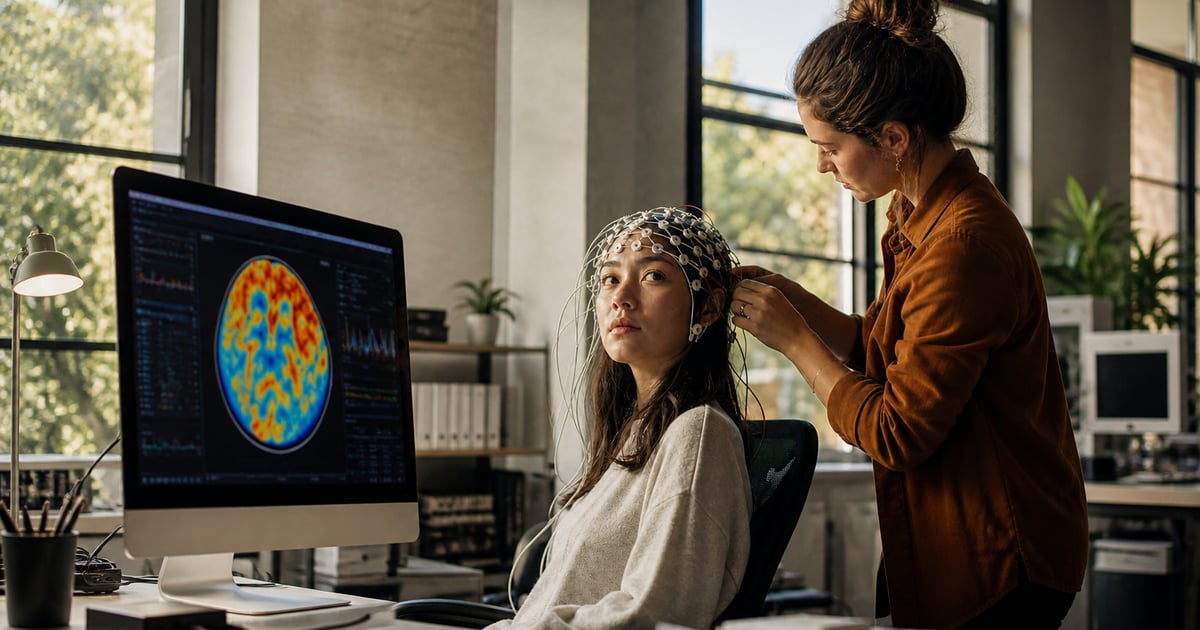
Introduction: Your Brain, Decoded Differently
Have you ever imagined that your brain activity could be read without even touching the back of your head? Until now, exploring your brain signals meant placing electrodes precisely on the back of your skull. Not always easy, especially if you have an injury or limited mobility. A recent neuroscience breakthrough, published in *Neuroscience: nature.com subject feeds*, is changing everything: thanks to artificial intelligence, it’s now possible to decode what’s happening in your brain… from your forehead. Dive into this innovation that could make brain-computer interfaces more accessible than e
Background: Why the Back of the Head Was Key
When we talk about decoding brain activity, we often think of EEGs and those electrodes placed on the scalp. To capture visual signals—especially SSVEPs (Steady-State Visually Evoked Potentials)—the tradition was to place everything at the back of the head, where the visual cortex is. But this classic method has many challenges: - **Hard to access** if you have bandages, injuries, or reduced mobility - **Uncomfortable** for people sensitive to electrode placement - **Excludes** many patients from brain-computer interfaces (BCIs) due to medical constraints So, the need for a more flexible and a
The Innovation: Decoding the Brain from the Forehead
A team of researchers has proven it’s possible to read visual brain activity… from the forehead. How? By using a deep learning network called DSTF-Net, which can reconstruct and interpret neural signals—even if they come from a less conventional area like the forehead. Here’s what’s new: - **Electrodes placed at the front of the head**, much simpler and more comfortable - **Visual signals interpreted** without direct access to the visual cortex - **Opens up to new patient profiles** This method is a major step forward for anyone who can’t use the classic electrode placement.
How Does DSTF-Net Work?
DSTF-Net (Deep Spatio-Temporal Fusion Network) is an artificial neural network specifically trained to reconstruct SSVEP signals from data collected far from the usual areas. In practice: - It **learns to recognize electrical patterns** typical of visual activities, even if they’re distorted or weakened by distance. - It **reconstructs these signals** to make them readable and usable by brain-computer interfaces. - It **adapts to individual variability**, making detection more reliable. This technology relies on powerful algorithms that can process large amounts of data in real time, paving th
Who Does This Innovation Change Things For?
This new process isn’t just a technical feat—it could transform many lives. Especially: - **People with limited mobility** (after an accident, surgery, or neurological illness) - **Patients with head injuries** that prevent electrode placement at the back - **BCI users wanting more comfort or discretion** Thanks to this approach, it’s now possible to imagine communication or control tools adapted to complex medical situations, without the usual technical obstacles.
What Science Says: Current Evidence and Limits
The study published in *Neuroscience: nature.com subject feeds* is based on an observational method. The results are promising: DSTF-Net can effectively decode SSVEP signals from the forehead in healthy participants. However, let’s keep in mind: - **Effectiveness needs to be confirmed** on a larger and more diverse sample, including patients with various medical conditions. - **The system requires personalized training** for each user, which can take time. - **Clinical applications are still being tested**: this is just a first step, not a ready-made solution. Still, this innovation opens up n
Limits, Challenges, and Promises Ahead
Even though the technology is promising, there are still challenges to overcome: - **Robustness and accuracy**: the system needs to become more reliable for use outside the lab. - **User acceptance and training**: people will need support to get comfortable with these new tools. - **Privacy concerns**: decoding the brain raises major ethical questions, especially about protecting neural data. In the long run, this approach could make communication easier for people who can’t speak or move, or even lead to innovative well-being tools.
How Lunaia Can Help You Take Care of Your Brain
Even if you don’t use a brain-computer interface, taking care of your mental health and well-being is essential. With Lunaia, you can: - **Do a daily check-in** to better understand your emotional state - **Practice breathing or guided meditation exercises** to calm your mind - **Follow personalized tips** to cultivate balance every day Lunaia is with you every step of the way, with no technical hassle—check out the app at https://lunaia.me and explore tools designed for adult mental well-being.
Reading Your Brain from the Forehead: The Neural Interface Revolution · Blog Lunaia